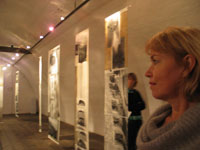
Valgerdur
Hauksdóttir’s career now spans more than two decades, decades that
have seen significant transformations in Icelandic art. Valgerdur’s
generation has taken on every artistic medium and even added more,
though there are also those who have stuck to traditional media and
continue to develop them and their own art, both technically and
in terms of ideology and approach. Valgerdur is nearly the only one,
though, to have made her mark in printmaking – a lone effort which
must test even a printer’s ample patience.
From
the start it was clear that prints suited Valgerdur: The abstract
perspective demanded by a method where one works not on the image
itself but on a plate or stone from which the image is then printed,
also the precise sense for materials and the sheer daring needed
to work in a medium that allows no mistakes. Technically, Valgedur
has indeed contributed to the art and there is much in her methods
and presentation that is wholly the fruit of her own research or
experimentation and which we do not see in the work of any other
printmakers – and not so many may have the technical knowledge anyway.
But she has also explored the world from many other perspectives
and incorporated them into her work. This can be seen both in her
subject matter, whether abstract or not, even photographic – but
also in her handling of the printed sheets, for example in works
that are built up like collages, layer by layer, from gossamer-thin
sheets of printed Japanese paper.
Printmaking
has its origin in the fifteenth century which saw a renaissance in
both art and technology. Printmaking was a way to mass-produce images
for distribution. In recent years, however, most of Valgedur’s pieces
have been unique, produced with a method that does not allow for
multiples. Yet the core material is still graphic – images printed
from plates that she reuses and even multiplies within a single piece.
Every one of Valgerdur Hauksdóttir’s exhibitions is a report from
an ongoing research project which does not permit time or energy
to be spent on reproduction. She has gained a technical proficiency
that allows her to take on subjects and conceptual problems that
are as fresh to us as they are to her, nuances of our experience
and dwelling in the world to which she brings as clear and incisive
an understanding as we can hope to see anywhere.
Jón
Proppé, critic and curator
(exhibition
catalogue- Turningpoint, Hafnarborg, 2006)